There are 32 signals total (see kernel_signal.h). They defined as order numbers [1 - 32].
The signals kernel API as follows:
- set construction by using _kernel_sigemptyset() and _kernel_sigaddset().
- probing by using _kernel_sigismember() and _kernel_sigpending().
- raise by using _kernel_raise().
- control by using _kernel_sigprocmask() for signals subscription and acknowledgement.
- flags state check by using _kernel_sigwait() blocking and _kernel_sigpending() none-blocking for signals await and/or poll
typical signals usage flow
- contruct a signals set _kernel_sigemptyset() and _kernel_sigaddset().
- subscribe signals set _kernel_sigprocmask() with SIG_BLOCK.
- wait or poll signals set _kernel_sigwait() blocking or _kernel_sigpending() none-blocking call.
- acknowledge signals set _kernel_sigprocmask() with SIG_UNBLOCK.
signals set blocking behaviour
When signals set constructed using multiple signals and in case of _kernel_sigwait() blocking call usage. It will return to (unblock) the main execution loop when any signal from the signals set is flagged. Each next call to _kernel_sigwait() should either block or return immediatly notifying next flag from the signals set reception. So _kernel_sigwait() calls in a loop can be used to await a whole signals set if neccessary.
- Note
- in blocking calls loop a received signal flagged from awaiting set has to be acknowledged prior to next _kernel_sigwait() otherwise it will return immediatly duplicating just received signal notification.
signals set none-blocking behaviour
_kernel_sigpending() has exact same as blocking _kernel_sigwait() behaviour apart from that it doesnt block a main execution loop and it constructs the signals set that indicates subscribed signals flagged at the moment of calling none-blocking _kernel_sigpending(). Signals acknowledgement necessity and behaviour in a case of calls loop is exact same.
signals set usage code snippets
- Note
- signals logic usage doesnt affect/alter the behaviour of a kernel event loop it designed to help introduce a separation between target software design and system level events (e.g. interrupts) to avoid overloading the event loop with not required target software subscribers
SIGIO
see Kernel STDIO
SIGINT, SIGBUS (notify / bus error)
It reserved a special meaning and such signals flow scheme can be presented on a following diagram
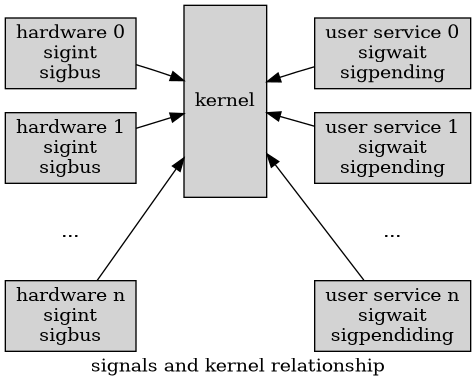
The scheme presents a number of target peripherals and each its driver raises SIGINT, SIGBUS (see _kernel_raise() with (SIGINT | SIGBUS)). The service either use _kernel_sigwait() blocking or _kernel_sigpending() none-blocking call and when SIGINT raised it can check using driver state if a 'right' SIGINT, SIGBUS raised.
- Note
- In case of a _kernel_sigwait() blocking call from a service the kernel pipeline halts preventing calling the subscribers for the events published so that the only case in using such a call is where a target really needs a hardware signal to continue operation by design e.g. a power managment service that hibernates (forces into sleep) the target until awakend. When _kernel_sigwait() called not from a service the kernel pipeline behaviour is as usual i.e. as for Kernel STDIO the kernel shell is not a service
In case of multiple hardware drivers raise SIGINT, SIGBUS a kernel supplies a semaphore for each signal meaning as long as semaphore value > 0 the kernel persists SIGINT, SIGBUS flagged until a number of raise and a number of signals acknowledge calls are matched in a given hardware notification time period. Each call to _kernel_raise with (SIGINT | SIGBUS) increases and _kernel_sigprocmask() with SIG_UNBLOCK, (SIGINT | SIGBUS) decreases corresponsing semaphore value. When semaphore value reaches 0 the kernel flags down either SIGINT or SIGBUS or both.
- Warning
- at the moment only SIGINT, SIGBUS have semaphores attached other signals dont. For these a _kernel_raise() and _kernel_sigprocmask() call flags up/down only. Its not designed reserving a special meaning for signals different from SIGINT, SIGBUS and SIGIO yet and maybe shall not in a future.