Kernel can run on any binary system platfrom and compile using target platform toolchain e.g. any gcc variant alike. There are APIs require implementation within the concrete target platform project. There are several compile instance profiles available each defines the number of APIs need in implementation. More...
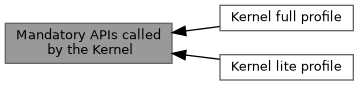
Modules | |
| Kernel lite profile | |
| Kernel lite variant. Includes a core with basic commands. | |
| Kernel full profile | |
| Kernel full variant. Includes a core and all currently available subsystems. | |
Files | |
| file | console.h |
| Console interface used by the Kernel Shell. | |
| file | disk.h |
| Disk low level I/O interface called by file I/O subsystem. | |
| file | fat.h |
| File system middleware interface called by file I/O subsystem. | |
| file | prompt.h |
| System prompt constructor interface used by the Kernel Shell. | |
Functions | |
| void | con_ln (void) |
| Moves cursor to the next line. | |
| void | con_tab (void) |
| Inserts a horizontal tab. | |
| void | con_clear (void) |
| Clears the console display. | |
| void | con_char (const char code) |
| Writes a single character to the console. | |
| void | con_string (const char *str) |
| Writes a null-terminated string to the console. | |
| void | con_xy (size_t cx, size_t cy) |
| Sets the cursor position. | |
| size_t | con_getx (void) |
| Retrieves the current cursor X position. | |
| size_t | con_gety (void) |
| Retrieves the current cursor Y position. | |
| void | set_con (void) |
| Initializes the console subsystem. | |
| void | disk_io (void) |
| Initializes the disk I/O module be a part of a file I/O subsystem. | |
| size_t | get_disks (void) |
| Returns the number of detected disks. | |
| void | get_disk (size_t did, disk_t *disk) |
| Retrieves disk descriptor by identifier. | |
| void | get_diskInfo (size_t did, char *dsk_info, size_t dsk_infoLen) |
| Retrieves human-readable disk information string. | |
| uint8_t | flush_disk (size_t did) |
| Flushes pending write operations to disk. | |
| uint8_t | read_disk (void *buffer, size_t did, size_t blck, size_t blocks) |
| Reads blocks from disk. | |
| uint8_t | write_disk (void const *buffer, size_t did, size_t blck, size_t blocks) |
| Writes blocks to disk. | |
| void | fat_getcwd (char *cwd) |
| Retrieves current working directory path. | |
| bool | fat_exists (char const *path) |
| Checks whether a file or directory exists. | |
| bool | fat_chdir (char const *cwd) |
| Changes current working directory. | |
| bool | fat_mkdir (char const *path) |
| Creates a new directory. | |
| bool | fat_unlink (char const *path) |
| Removes a file or directory. | |
| bool | fat_mount (char const *path) |
| Mounts a FAT filesystem. | |
| bool | fat_unmount (char const *path) |
| Unmounts a FAT filesystem. | |
| bool | fat_stat (char const *path, filinfo_t *fno) |
| Retrieves file or directory metadata. | |
| fat_error_code_t | fat_getcode (void) |
| Returns last FAT error code. | |
| void | fat_fclose (int fd) |
| Closes an open file descriptor. | |
| int | fat_fopen (char const *path, file_access_t mode) |
| Opens a file. | |
| size_t | fat_fsize (int fd) |
| Returns file size. | |
| size_t | fat_fread (int fd, void *buffer, size_t nread) |
| Reads data from file. | |
| size_t | fat_fwrite (int fd, void const *buffer, size_t nwrite) |
| Writes data to file. | |
| void | fat_ls (char const *path, void const *ls_ctx, void(*nxt_file)(void const *ls_ctx, filinfo_t const *fi)) |
| Lists directory contents. | |
| void | _shell_prompt (char *prompt, const size_t p_len) |
| Generates or retrieves the current shell prompt string. | |
Variables | |
| size_t | MAX_X |
| Maximum horizontal coordinate of the console. | |
| size_t | MAX_Y |
| Maximum vertical coordinate of the console. | |
Detailed Description
Kernel can run on any binary system platfrom and compile using target platform toolchain e.g. any gcc variant alike. There are APIs require implementation within the concrete target platform project. There are several compile instance profiles available each defines the number of APIs need in implementation.
Function Documentation
◆ _shell_prompt()
| void _shell_prompt | ( | char * | prompt, |
| const size_t | p_len | ||
| ) |
Generates or retrieves the current shell prompt string.
- Parameters
-
[out] prompt Output buffer receiving the prompt string. [in] p_len Length of the output buffer in bytes.
- Precondition
- prompt must not be NULL.
- p_len > 0.
- Postcondition
- prompt contains a null-terminated string on success.
- The string is truncated if the buffer is insufficient.
Writes the current shell prompt into the provided buffer. The prompt format is implementation-defined and may include contextual information such as:
- Current working directory
- User name
- System state indicators
The function guarantees null-termination provided p_len > 0.
- Side Effects:
- None expected (read-only state access).
- Warning
- The caller is responsible for providing a sufficiently large buffer to avoid truncation.
◆ con_char()
| void con_char | ( | const char | code | ) |
Writes a single character to the console.
- Parameters
-
[in] code Character to display.
Writes the specified character at the current cursor position and advances the cursor according to implementation rules.
- Note
- Control characters may be handled specially.
- Side Effects:
- Modifies display buffer.
- Updates cursor position.
◆ con_clear()
| void con_clear | ( | void | ) |
Clears the console display.
Clears the entire screen buffer and resets the cursor to the origin position (0,0).
- Postcondition
- Screen buffer is cleared.
- Cursor position is (0,0).
- Note
- When concrete console module doesnt support screen buffer clear (e.g. tty) it can be empty implemented. e.g. void con_clear() { }
- Side Effects:
- Modifies the entire display buffer.
◆ con_getx()
| size_t con_getx | ( | void | ) |
Retrieves the current cursor X position.
- Returns
- Current horizontal cursor position.
Returns a value in the range [0, MAX_X - 1].
◆ con_gety()
| size_t con_gety | ( | void | ) |
Retrieves the current cursor Y position.
- Returns
- Current vertical cursor position.
Returns a value in the range [0, MAX_Y - 1].
◆ con_ln()
| void con_ln | ( | void | ) |
Moves cursor to the next line.
Advances the cursor to the beginning of the next line. Scrolling behavior is implementation-defined if the cursor is currently on the last line.
- Postcondition
- Cursor X position is reset to 0.
- Side Effects:
- May trigger screen scrolling.
◆ con_string()
| void con_string | ( | const char * | str | ) |
Writes a null-terminated string to the console.
- Parameters
-
[in] str Pointer to null-terminated character string.
- Precondition
- str must not be NULL.
Writes characters sequentially starting at the current cursor position. Cursor advancement and wrapping behavior are implementation-defined.
- Side Effects:
- Modifies display buffer.
- Updates cursor position.
◆ con_tab()
| void con_tab | ( | void | ) |
Inserts a horizontal tab.
Advances the cursor to the next tab stop. Tab width is implementation-defined.
- Side Effects:
- Modifies cursor position.
◆ con_xy()
| void con_xy | ( | size_t | cx, |
| size_t | cy | ||
| ) |
Sets the cursor position.
- Parameters
-
[in] cx Horizontal position (column index). [in] cy Vertical position (row index).
- Precondition
- cx < MAX_X
- cy < MAX_Y
Moves the cursor to the specified coordinates. Behavior is undefined if parameters exceed console bounds unless explicitly handled by implementation.
- Note
- When console doesnt support coordinates navigation (e.g. tty) it can be empty implemented e.g. void con_xy(size_t x, size_t y) { }
- Side Effects:
- Modifies internal cursor state.
◆ disk_io()
| void disk_io | ( | void | ) |
Initializes the disk I/O module be a part of a file I/O subsystem.
Performs hardware detection, driver initialization, and prepares internal file I/O subsystem disk tables.
Must be called before invoking other disk API functions.
- Postcondition
- Disk I/O is ready for operations.
- Side Effects:
- May access hardware.
- Initializes internal static state.
◆ fat_chdir()
| bool fat_chdir | ( | char const * | cwd | ) |
Changes current working directory.
- Parameters
-
[in] cwd Target directory path.
- Return values
-
true Directory change successful. false Failure (see fat_getcode()).
◆ fat_exists()
| bool fat_exists | ( | char const * | path | ) |
Checks whether a file or directory exists.
- Parameters
-
[in] path Path to file or directory.
- Returns
- true if object exists. false otherwise.
◆ fat_fclose()
| void fat_fclose | ( | int | fd | ) |
Closes an open file descriptor.
- Parameters
-
[in] fd File descriptor.
◆ fat_fopen()
| int fat_fopen | ( | char const * | path, |
| file_access_t | mode | ||
| ) |
Opens a file.
- Parameters
-
[in] path File path. [in] mode File access mode flags.
- Returns
- Non-negative file descriptor on success. Negative value on failure (see fat_getcode()).
◆ fat_fread()
| size_t fat_fread | ( | int | fd, |
| void * | buffer, | ||
| size_t | nread | ||
| ) |
Reads data from file.
- Parameters
-
[in] fd File descriptor. [out] buffer Destination buffer. [in] nread Number of bytes to read.
- Returns
- Number of bytes actually read.
- Precondition
- buffer must not be NULL.
◆ fat_fsize()
| size_t fat_fsize | ( | int | fd | ) |
Returns file size.
- Parameters
-
[in] fd File descriptor.
- Returns
- File size in bytes.
◆ fat_fwrite()
| size_t fat_fwrite | ( | int | fd, |
| void const * | buffer, | ||
| size_t | nwrite | ||
| ) |
Writes data to file.
- Parameters
-
[in] fd File descriptor. [in] buffer Source buffer. [in] nwrite Number of bytes to write.
- Returns
- Number of bytes actually written.
◆ fat_getcode()
| fat_error_code_t fat_getcode | ( | void | ) |
Returns last FAT error code.
- Returns
- Most recent fat_error_code_t value.
◆ fat_getcwd()
| void fat_getcwd | ( | char * | cwd | ) |
Retrieves current working directory path.
- Parameters
-
[out] cwd Output buffer for path string.
- Precondition
- cwd must not be NULL.
- Note
- Buffer size must be sufficient for full path.
◆ fat_ls()
| void fat_ls | ( | char const * | path, |
| void const * | ls_ctx, | ||
| void(*)(void const *ls_ctx, filinfo_t const *fi) | nxt_file | ||
| ) |
Lists directory contents.
- Parameters
-
[in] path Directory path. [in] ls_ctx User-defined data context pointer. [in] nxt_file Callback invoked for each directory entry.
Iterates through directory entries and invokes the callback for each discovered file passing user defined data context object pointer
- Precondition
- nxt_file must not be NULL.
- Warning
- Callback must not modify filesystem state otherwise a behaviour is undefined.
◆ fat_mkdir()
| bool fat_mkdir | ( | char const * | path | ) |
Creates a new directory.
- Parameters
-
[in] path Directory path.
- Return values
-
true Directory created successfully. false Failure (see fat_getcode()).
◆ fat_mount()
| bool fat_mount | ( | char const * | path | ) |
Mounts a FAT filesystem.
- Parameters
-
[in] path Mount source (device path).
- Return values
-
true Mount successful. false Mount failed (see fat_getcode()).
- Postcondition
- Filesystem is ready for access on success.
◆ fat_stat()
| bool fat_stat | ( | char const * | path, |
| filinfo_t * | fno | ||
| ) |
Retrieves file or directory metadata.
- Parameters
-
[in] path Target path. [out] fno Output file information structure.
- Return values
-
true Information retrieved successfully. false Failure (see fat_getcode()).
◆ fat_unlink()
| bool fat_unlink | ( | char const * | path | ) |
Removes a file or directory.
- Parameters
-
[in] path Target path.
- Return values
-
true Removal successful. false Failure (see fat_getcode()).
◆ fat_unmount()
| bool fat_unmount | ( | char const * | path | ) |
Unmounts a FAT filesystem.
- Parameters
-
[in] path Mount source.
- Return values
-
true Unmount successful. false Unmount failed (see fat_getcode()).
◆ flush_disk()
| uint8_t flush_disk | ( | size_t | did | ) |
Flushes pending write operations to disk.
- Parameters
-
[in] did Disk identifier.
- Returns
- Disk I/O status code.
- Return values
-
DISK_IO_OK Flush successful. DISK_INVALID Invalid disk identifier parameter DISK_NOT_READY Disk not initialized. DISK_IO_ERR Hardware error occurred.
- Side Effects:
- May trigger physical media write.
◆ get_disk()
| void get_disk | ( | size_t | did, |
| disk_t * | disk | ||
| ) |
Retrieves disk descriptor by identifier.
- Parameters
-
[in] did Disk identifier. [out] disk Pointer to disk descriptor structure.
- Precondition
- disk must not be NULL.
- did must refer to a valid disk.
- Postcondition
- disk structure is populated on success.
- Warning
- Behavior is undefined if disk is NULL.
◆ get_diskInfo()
| void get_diskInfo | ( | size_t | did, |
| char * | dsk_info, | ||
| size_t | dsk_infoLen | ||
| ) |
Retrieves human-readable disk information string.
- Parameters
-
[in] did Disk identifier. [out] dsk_info Output buffer for disk information string. [in] dsk_infoLen Length of output buffer in bytes.
- Precondition
- dsk_info must not be NULL.
- dsk_infoLen > 0.
Writes a null-terminated string describing the disk. Output is truncated if buffer is insufficient.
- Side Effects:
- Modifies dsk_info buffer.
◆ get_disks()
| size_t get_disks | ( | void | ) |
Returns the number of detected disks.
- Returns
- Number of available disk devices.
- Return values
-
0 No disks detected or module not initialized.
◆ read_disk()
| uint8_t read_disk | ( | void * | buffer, |
| size_t | did, | ||
| size_t | blck, | ||
| size_t | blocks | ||
| ) |
Reads blocks from disk.
- Parameters
-
[out] buffer Destination buffer. [in] did Disk identifier. [in] blck Starting block index. [in] blocks Number of blocks to read.
- Returns
- Disk I/O status code.
- Return values
-
DISK_IO_OK Read successful. DISK_INVALID Invalid parameters. DISK_NOT_READY Disk not initialized. DISK_IO_ERR Hardware read failure.
- Precondition
- buffer must not be NULL.
- blocks > 0.
- blck + blocks must not exceed disk capacity.
- Side Effects:
- Modifies contents of buffer.
◆ set_con()
| void set_con | ( | void | ) |
Initializes the console subsystem.
Performs required hardware or buffer initialization and prepares the console for output operations.
Must be called before using any other console function.
- Postcondition
- Console is ready for output.
- MAX_X and MAX_Y are initialized.
- Side Effects:
- Initializes internal state.
- May access hardware registers or memory-mapped I/O.
◆ write_disk()
| uint8_t write_disk | ( | void const * | buffer, |
| size_t | did, | ||
| size_t | blck, | ||
| size_t | blocks | ||
| ) |
Writes blocks to disk.
- Parameters
-
[in] buffer Source buffer. [in] did Disk identifier. [in] blck Starting block index. [in] blocks Number of blocks to write.
- Returns
- Disk I/O status code.
- Return values
-
DISK_IO_OK Write successful. DISK_WRITE_PROTECT Media is write-protected. DISK_INVALID Invalid parameters. DISK_NOT_READY Disk not initialized or media not ready DISK_IO_ERR Hardware write failure.
- Precondition
- buffer must not be NULL.
- blocks > 0.
- blck + blocks must not exceed disk capacity.
- Side Effects:
- Modifies disk media.
- May trigger physical write operation.
- Warning
- Data integrity is not guaranteed unless flush_disk() is called after write operations when required.
Variable Documentation
◆ MAX_X
|
extern |
Maximum horizontal coordinate of the console.
Represents the maximum valid X coordinate (column index). Valid cursor X positions range from 0 to (MAX_X - 1).
- Note
- Value is implementation-defined and must be initialized during console subsystem / module implementation. Must be initialized. When concrete console module doesnt support X coordinate navigation (e.g. tty) it must be initialized as zero
◆ MAX_Y
|
extern |
Maximum vertical coordinate of the console.
Represents the maximum valid Y coordinate (row index). Valid cursor Y positions range from 0 to (MAX_Y - 1).
- Note
- Value is implementation-defined and must be initialized during console subsystem / module implementation. Must be initialized When concrete console module doesnt support Y coordinate navigation (e.g. tty) it must be initialized as zero